Our Himalayan trek was one of the key bucket list items on our megamoon. To say it did not disappoint is an understatement. It proved to be a fantastic way for us to experience the real, rural Nepal beyond the backpacker luxuries in Thamel and Pokhara, while also exploring the beautiful scenery: rice paddy terraces, rhododendron forests and, of course, simply breathtaking views of the largest peaks in the world. Add to all this the benefit us having a local guide and porter and Nepali teahouses / lodges available for us to stay at every step of the journey, with a warm fire, masala tea and hot meal waiting for us. It is simply an incredible (and also affordable) package.
We were a little concerned initially about trekking in the winter but discovered there are plenty of trails that stay safely below the bulk of the snow and avalanche risks. We had read great things about the popular Ghorepani – Poon Hill – Ghandruk trek but were also keen not to feel like we were part of a conveyor belt of trekkers. In the end, with advice from 3 Sisters, our trekking agency, we designed a mixed 7 day route, starting with a 4 day walk up a less well trodden valley with lots of rural scenery and villages, and cross over the peaks of Mohare Danda (3,300m), Poon Hill (3,200) over to more classical trails. We decided to add the optional target of reaching Muldai peak (3,700m) – weather and appetite depending! Having had our briefing with Shanti (our female guide) and Abicheck (our assistant) and got all our gear ready, we were psyched…
Day 1, 16th Jan, Naya Pul (1,000m) to Purnagaon (1,400m):
We met Shanti and Abicheck (or Abi) at the 3 Sisters Trekking Agency in Lakeside. Our hostel had been very happy to keep our backpacks with the bulk of our stuff. The drive to Nayapul took around 1.5 hours on a mostly good but windey road. We drove north up to Sarankot – a viewpoint above Pokhara which is also the launchpad for all the para gliders in the area – and then down windy roads to the village of Nayapul. This is there the “good road” ends and is a logical starting point for many treks in the area. Unfortunately, the weather was not good. The overcast skies and persistent drizzle gave it a distinctly British feel… We had teas at a restaurant / tea house, got our waterproofs on and off we went!
We first walked through the village of Nayapul, crossed a large rope footbridge over a river, past the local school and onto a dirt track on the other side. The track steadily inclined for a good while before we eventually turned off onto a genuine footpath. We started to get to know Shanti a bit better and hearing some great stories about previous treks she had led. Shanti is from the Rai community, from a remote village in Eastern Nepal, not far from Lukla and Everest in relative terms.
We were told that the views were usually really beautiful, overlooking valleys dotted with villages and a mix of forest and terraced mountainside with rice paddies. The thick cloud had, unfortunately, dismantled the view for us. The rain also grew steadily heavier without ever reaching cataclysmic levels. It was enough for us to start feeling very sodden… especially George who had foolishly turned down the offer of a poncho at the Nayapul teahouse. It turns out “waterproof” is a relative term when it comes to jackets. We reached a village that had a simple teahouse (basically a lady’s dining room) around 13.00 and George stripped his coat to find his inner layers totally soaked. We had veg. noodles for lunch while George got dry and changed clothes. On leaving, we purchased a makeshift poncho out of what was effectively a large blue plastic bag. The bag was cumbersome and hilariously unfashionable to wear but certainly did the job and kept George vastly drier over the next day or so of rain that we had.
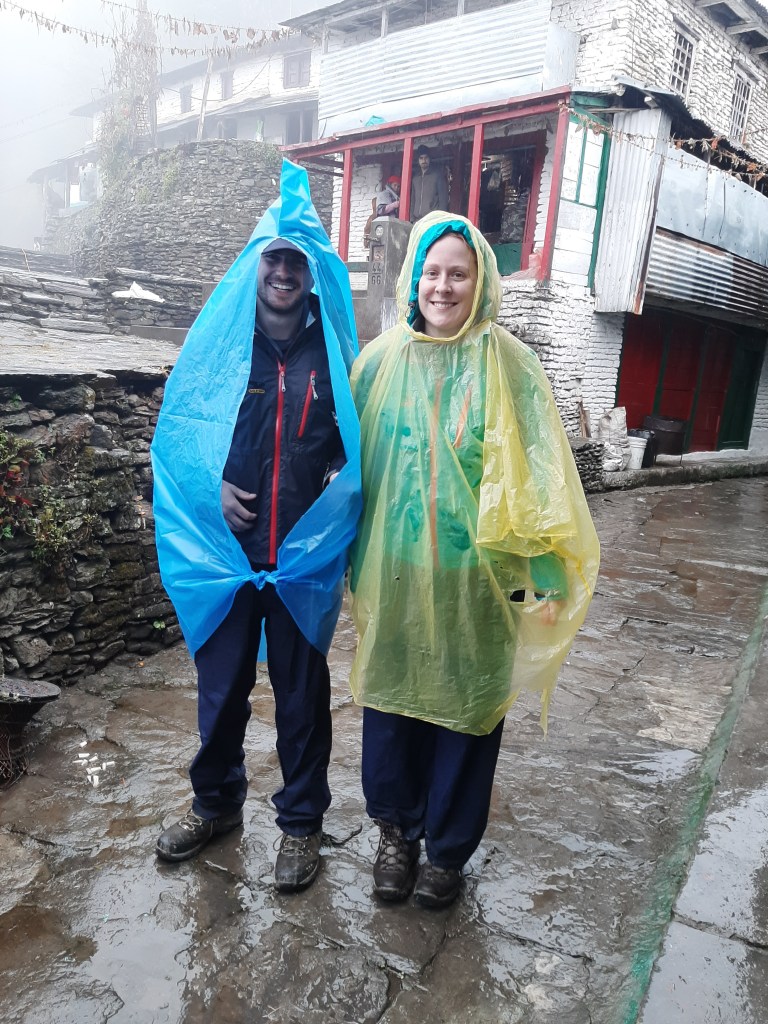
After walking for another hour, the trail took a steep incline up the side of the valley, straight up in a staircase. Another hour of hard work later, we arrived at the tiny village of Purnagaon. Our tea house was effectively a super rustic converted house – but it had a really cozy feel. The living space was a wooden extension built on stilts over the mountainside with 5 or 6 bedrooms just below. Needless to day there was no heating or in this case even windows so blankets and hudling were a must! We had a Dal Bhat dinner and went to bed trying to watch the Inbetweeners 2 movie (the 4G surprisingly lasted us for some time but died shortly after 9pm).
Day 2, 17th Jan, Purnagaon to Lespar (1,900m)
We woke up at around 6.45am but were slightly thrown by it still being totally dark. What little light that was coming through from dawn was being blocked by thick cloud (and, of course, more rain) and the tea house had no power. We ventured upstairs and had omelette with chapati for breakfast, packed our things and were on our way again by about 8.30. While it was still raining heavily, the cloud was higher than the previous day so we had something of a view which was an improvement.
We walked for a couple of hours along a mix of dirt tracks and stone footpaths until eventually we took shelter in the cute village of Gunga, under someone’s porch. We had some of our peanuts and sultanas, and Shanti was insistent on sharing her various Nepali snacks that were simple, tasty and healthy (yam, squash and dry seeds). The trail then grew more interesting, going into thick rhododendron forest (our first of many!), before leading to another steep staircase for 1h up to the village of Lespar. We had walked in good time, making day 2 quite a short day and getting us to Lespar well in time for lunch.
Lespar village itself was really picturesque, and as the rain and heavy cloud gradually eased over the course of the afternoon, the view got better and better. The houses are made of stone with slate roofs and are largely painted white with a significant number going for brighter colours of blue or green. Our tea house was positively posh compared to Purnagaon – a modern stone and concrete building with actual doors and windows for one! It also had a spacious communal and dining area and, crucially, a barn with an open fire inside which we spent most of the afternoon by keeping warm, reading and chatting. George had Dal Bhat (again) for dinner while Katharine had veg. fried rice. We later joined Shanti and our host / chef who was a local lady in her late 30s / 40s who was really warm, a great cook but spoke no English; and sampled a glass each of raksi – Nelapese millet wine. It was very much homemade, surprisingly tasty and had no way of knowing how strong it was.
Day 3, 18th Jan, Lespar to Nangi (2,300m)
Finally, the rain stopped. We woke up around dawn time (6.45) and for the first time got a view and a sense of the sensational beauty of the countryside we had been in for two days already. Lespar is perched on a west-facing slope, granting us beautiful panoramic views with sunrise looking down the valley and mountains across.
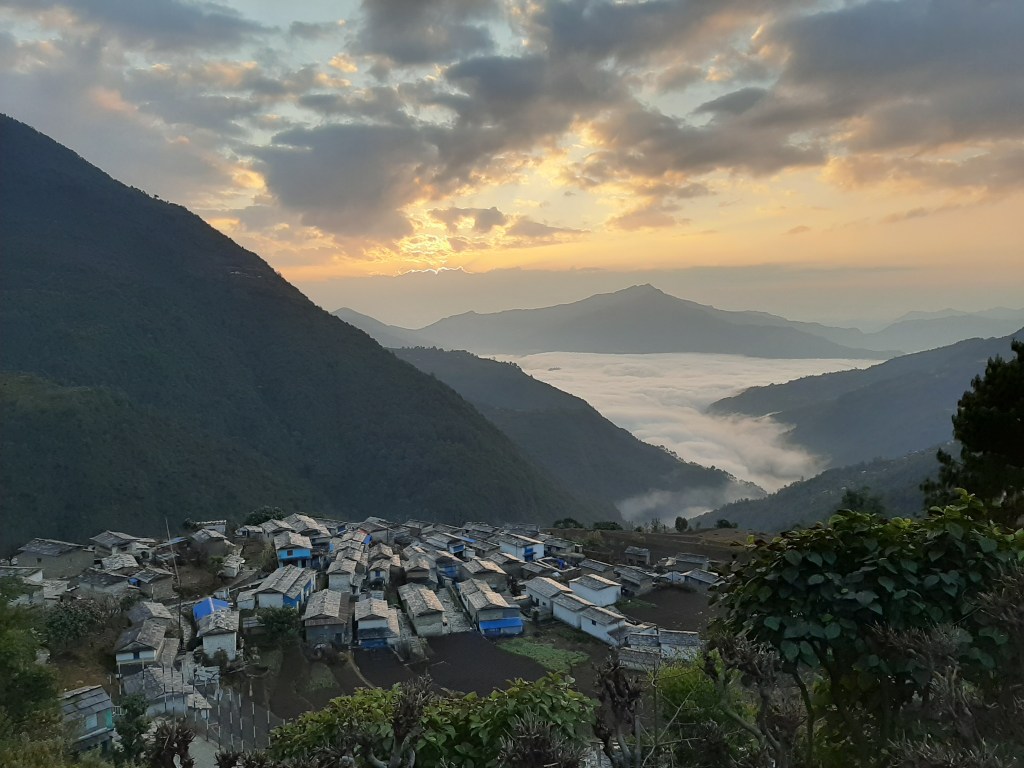
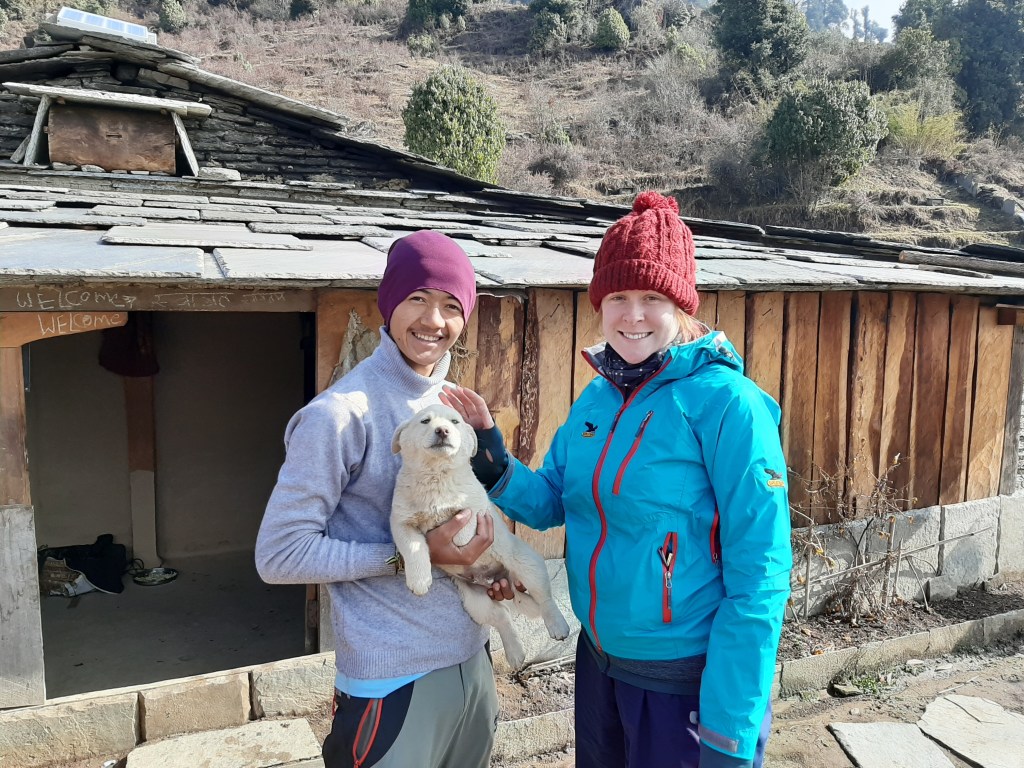
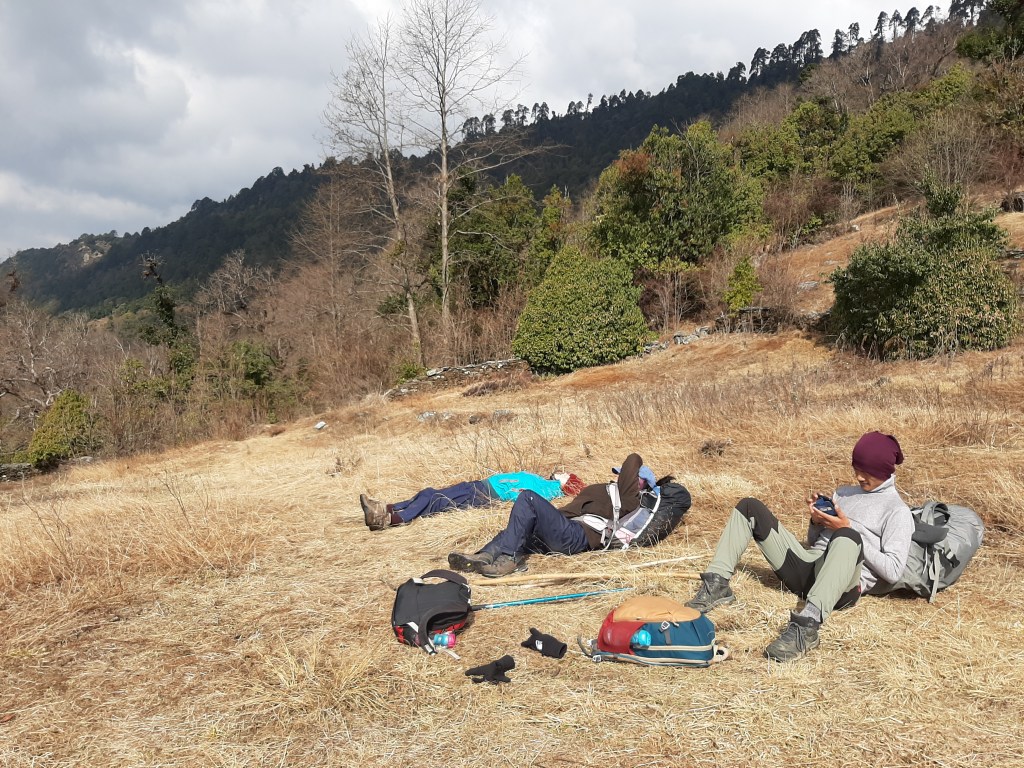
We had breakfast and set off around 8.30 – this time without our ridiculous self-made plastic ponchos. The path climbed steeply for the first hour until we came out over a mountain pass from where we could see the next set of valleys, all dotted with villages and terraces. We continued to climb more steadily through more rhododendron forest until we came to a small stone farmhouse in a clearing. We gladly took up Shanti’s suggestion of a tea stop. The place was inhabited by the cutest old lady and the cutest puppy (like a very fluffy, golden labrador). We had our packed lunch of chapatis and boiled eggs about a hour later in a beautiful mountain meadow with glorious views of the valley below. Shanti shared a jar of spicy pickle which we used to enhance our lunch.
After lunch, the path grew steeper once more until we came to another pass, which at 2,500m was just below the snow line. From this point we had a good view of our planned route. Our overnight stop, the village of Nangi, lay in the next valley below. Above the snow line to our right was the ridge on which Mohare Danda and Poon Hill are located. Shanti warned us the route to Mohare may be unpasable due to the thick snow that had felled over the last few days – it was clear to see from the snow line not far from us that the trees were properly buried. Looking further to the north-east, the clouds had started to part revealing a tantalising, incomplete of the massive, pointy peak of Annapurna South (7,200 odd metres). Despite being separated by another valley, the size made it seem very very close. The final stage of the day’s walk was a fairly unpleasant seemingly endless slippery and steep stone staircase that led us down to the village of Nangi (2,300m).
Nangi is an important village in the area, but as it is effectively a wide collection of farm houses, doesn’t really have a village feel to it. We stayed the night not at a Tea House, but at the Nangi Community Lodge, co-built by UNDP and the Nepal Government. The place was good in terms of facilities, particularly the large communal and dining area with a much needed wood burner in the middle, but lacked the warmth and hospitslity of the privately owned tea houses we stayed in. The food prices were also far steeper, although presumably proceeds go to the community development fund. Shanti took us a little further along the path to see a traditional Nepalese paper making cooperative and the local high school. It being Saturday, the place was sadly closed, but it was still interesting to see something more of the village.
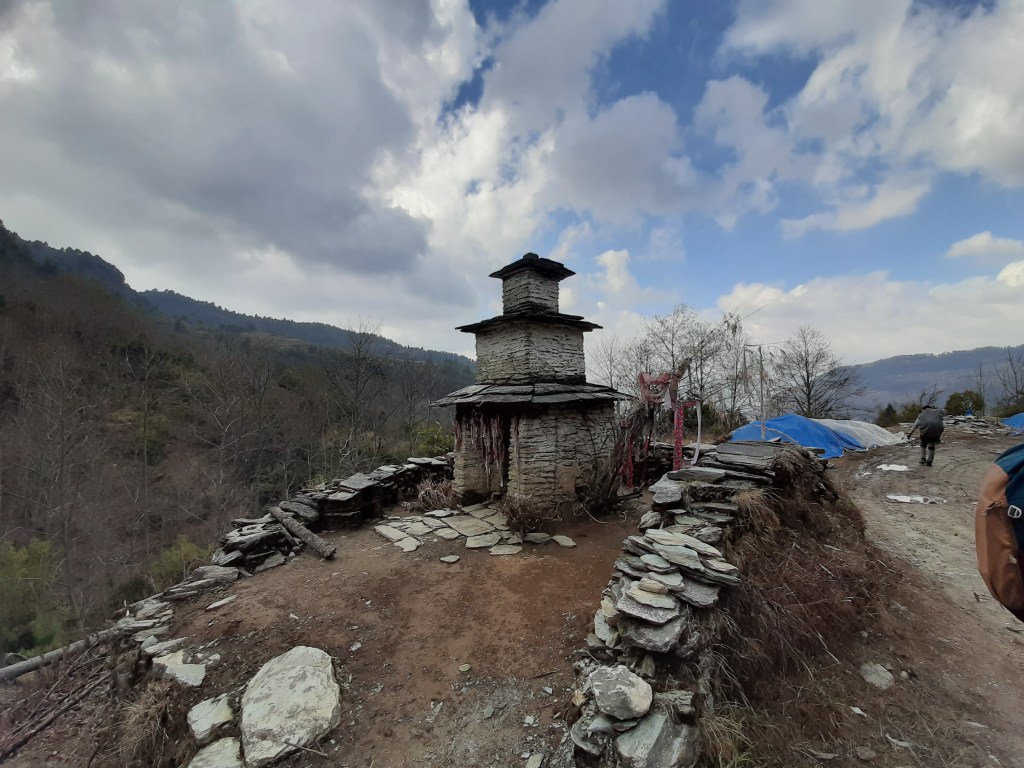
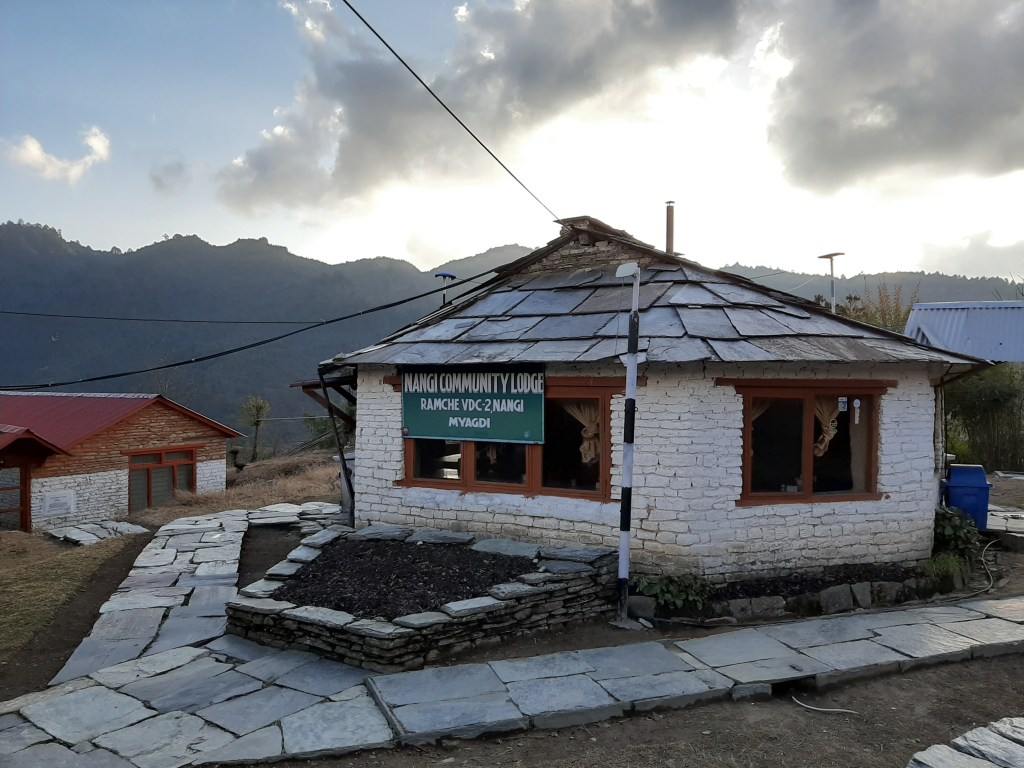
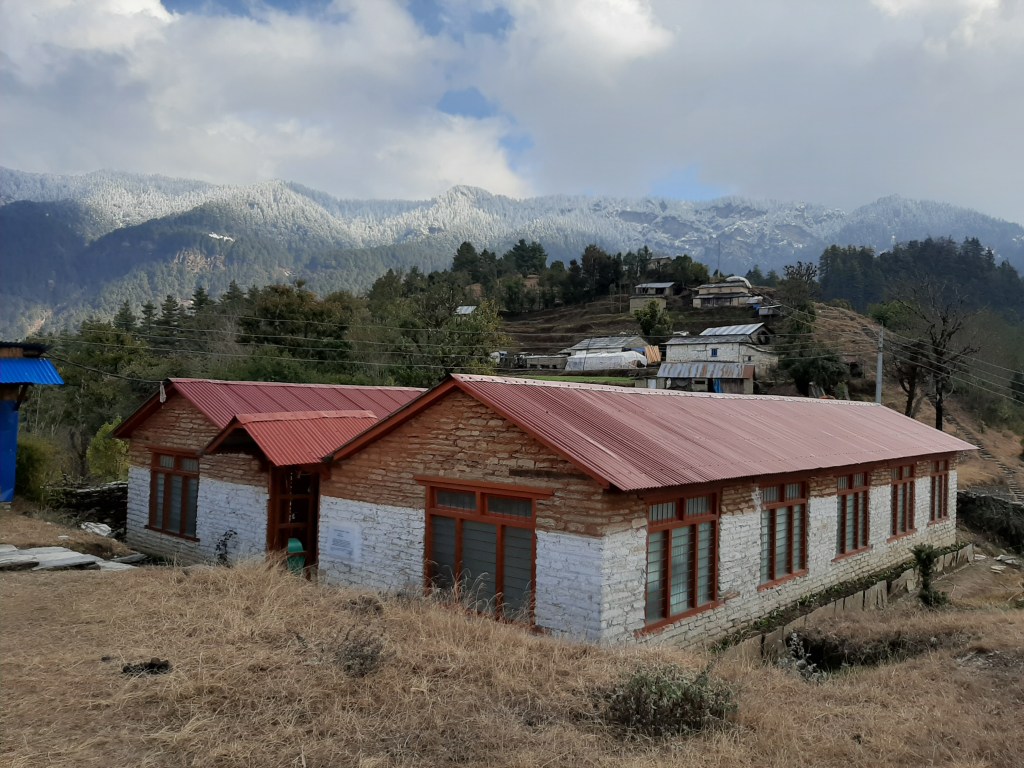
We had read in the Lonely Planet that apple pie was often available in the Himalayan tea houses – curious as to what this Nepali version was like we sought it out over the coming days. Our lodge only did “apple fritters” – effectively fried apple pieces – which we had alongside our noodle / dal bhat dinner. It was not particularly exciting. The skies had cleared by night time, and so after spending some time stargazing in the cold at the stunningly bright and busy sky (you could make out the Milky Way), we headed for bed.
Day 4, 19th Jan, Nangi to Phulbari (2,900m)
Our original planned destination for day 4 was the peak of Mohare Danda at 3,300m. News from the folks in Nangi was that nobody had been up to Mohare and that the community lodge there were heavily snowed in and had no running water. Shanti, quite sensibly, advised we alter our route, which we agreed to. Our plan was, instead, to aim for a teahouse in a place called Phulbari for lunch. From there we could make an assessment of if we wanted to stay overnight or continue up and over Poon Hill to the village of Ghorepani.
We woke to beautiful clear skies and could see Annapurna South and Tilitso Himal both towering over the valley to the north-east from us. We had porridge, honey and apple for breakfast (this became something of a staple in the coming days given it was warm, tasty and full of energy) and set off at around 8.15. We traversed for 30 minutes or so down and along the side of the valley, before crossing a stream and climbing back up the other side. Eventually we turned off the dirt track and up another steep staircase straight up the valley side. We paused a few times to catch our breath while taking in the stunning scenery, layers of terraces with potatoes, rice, lettuce etc. interspersed with pockets of rhododendron forest. We climbed for an hour or so until we eventually reached the top of the ridge, opening up the views, although clouds had come in by this point. As soon as we hit the top of the ridge, we were in the snow-line, albeit with the snow patchy and slushy here. We had a break in a clearing by an under-construction tea house where we also nibbled on dry seeds and fresh squash like mini butternut squash) with a single stone in the middle) with chilli and salt that Shanti had shared.
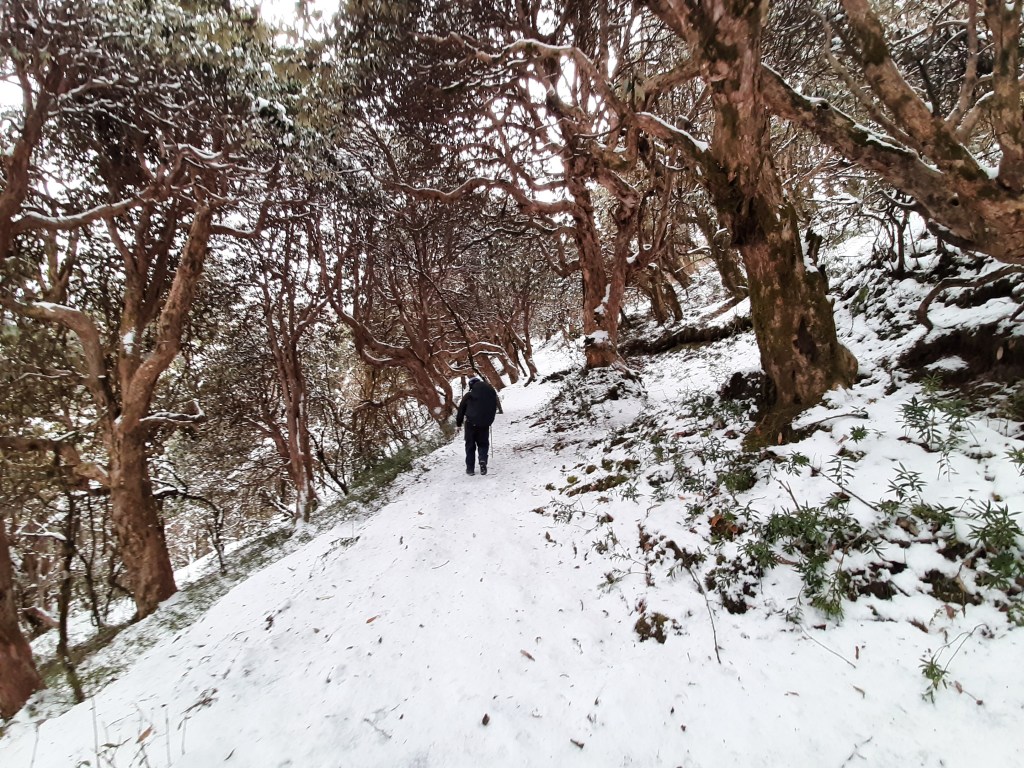
Setting off uphill towards the snow, this was where we encountered the first other trekker: a European young woman with a single Nepali guide, who, wide eyed, said “good luck”… As we climbed, we began to see what she was talking about. The trail climbed gradually through increasingly thick forest of ancient rhododendron trees, more and more of the path was covered in a frozen snow and ice making it very slippery in places. Katharine, who’s boots were the oldest and least grippy, eventually added the micro-spikes we had been carrying to her boots which made a huge difference. Walking through these ancient, snow-covered forests was very picturesque and added a new level of beauty to the terrain. The snow steadily got thicker and by the time we reached Phulbari it was a good 75cm deep powdery snow.
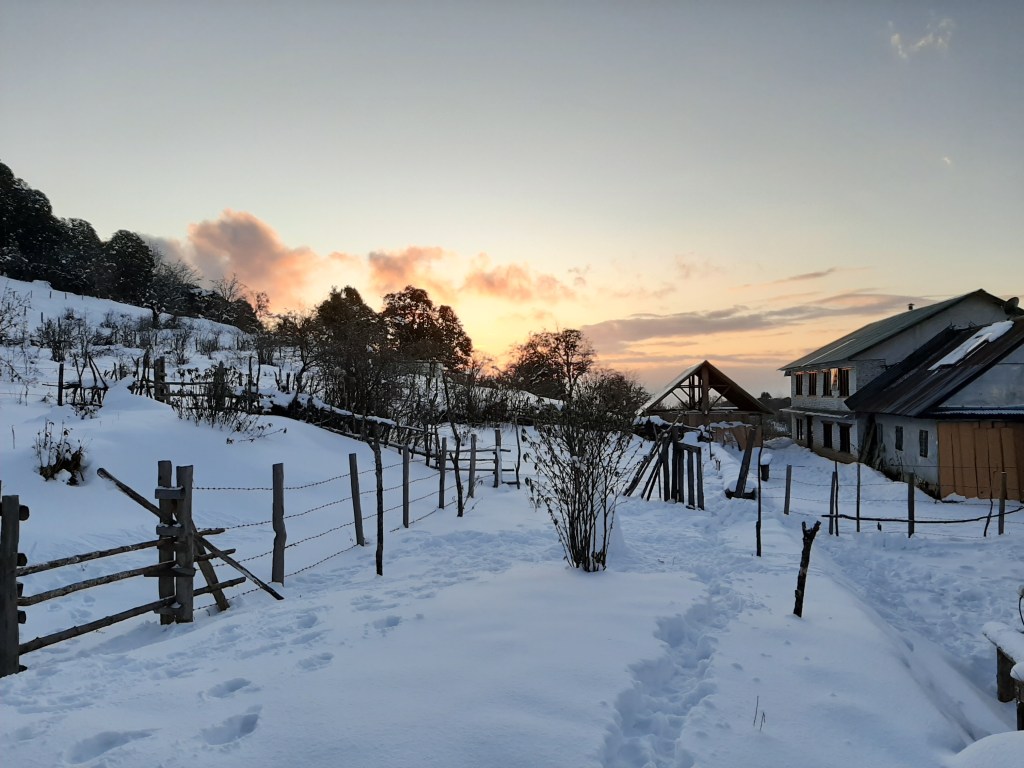
Phulbari is a small clearing in the forest and provides something of a junction for a number of routes in the area. The tea house itself was very nice, with a lovely, cozy communal area with windows all around the external walls and a vital wood burner in the middle. As soon as we cooled down from our walking, this proved to be our lifeline, as the building itself was thin wood panelled and the locals seem to never shut the doors when they enter or exit the room – an inexplicable habit for somewhere so cold!
After eating lunch, we watched two young Nepali lads from a village not far from Nangi attempt to hike up the totally buried trail towards Mohare Danda. It was utterly comical and very foolish. They were both wearing trainers, one was in jeans, neither had proper waterproofs, but no matter what gear you had (apart from snowshoes maybe!), the trail was impassable. We watched them take 45 minutes to cover about 50 metres of ground up a steep slope. With every step they took, they sunk waist high into snow. It soon started snowing heavily again and the teahouse manager and Shanti both shouted after them to come back. Eventually, they did return, completely drenched and frozen.
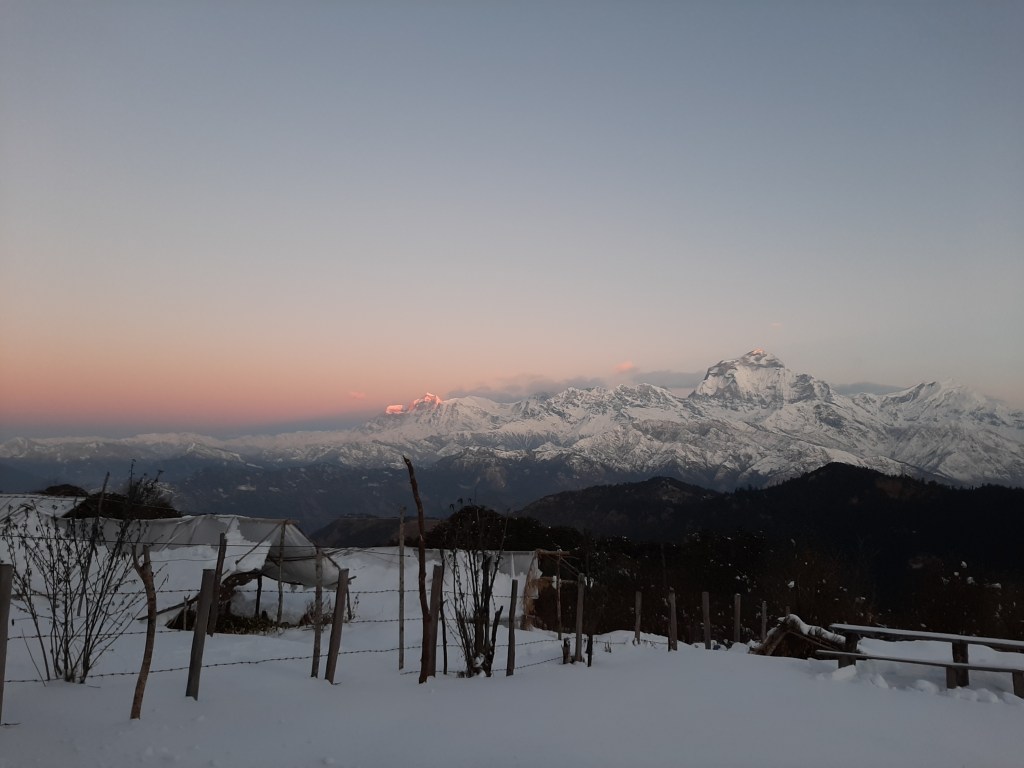
As the snow had started falling heavily again, we took the decision to wait until the morning before going on to Poon Hill and Ghorepani: we didn’t fancy getting stuck in a blizzard on the mountain and even if we had made it to Poon hill, we would have seen nothing of the views with the weather so bad. We spent the afternoon reading, snoozing and chilling by the warm wood burner instead, which was really nice. As the evening drew in, the clouds gradually begun to dissipate, revealing an absolutely sensational panoramic view of mountains of epic scale from the living room we were sat in. Opposite from us, we could see the monstrous Daulagiri peak (over 8,000m high and the 7th highest peak in the world), further to the right, the many Annapurna peaks also appeared.
Despite how cut off this place felt, they had apple pie on the menu, which we just had to sample with our dinner. It ended up looking very much like a Cornish pasty! As the teahouse don’t have ovens, their method of cooking apple pie entails creating a pie out of apple, chocolate and chapati as a pastry, and then frying it. It was surprisingly tasty! We headed to bed in our desperately cold room that had barely a centimetre separating us from the ice world outside. Simply changing our clothes and going to the toilet was painful. We ended up making use of the hot water bottle in our drinking bottle trick to warm up our sleeping bags, and slept in full thick thermals, socks, gloves and woolly hats (Katharine also wore her down jacket).
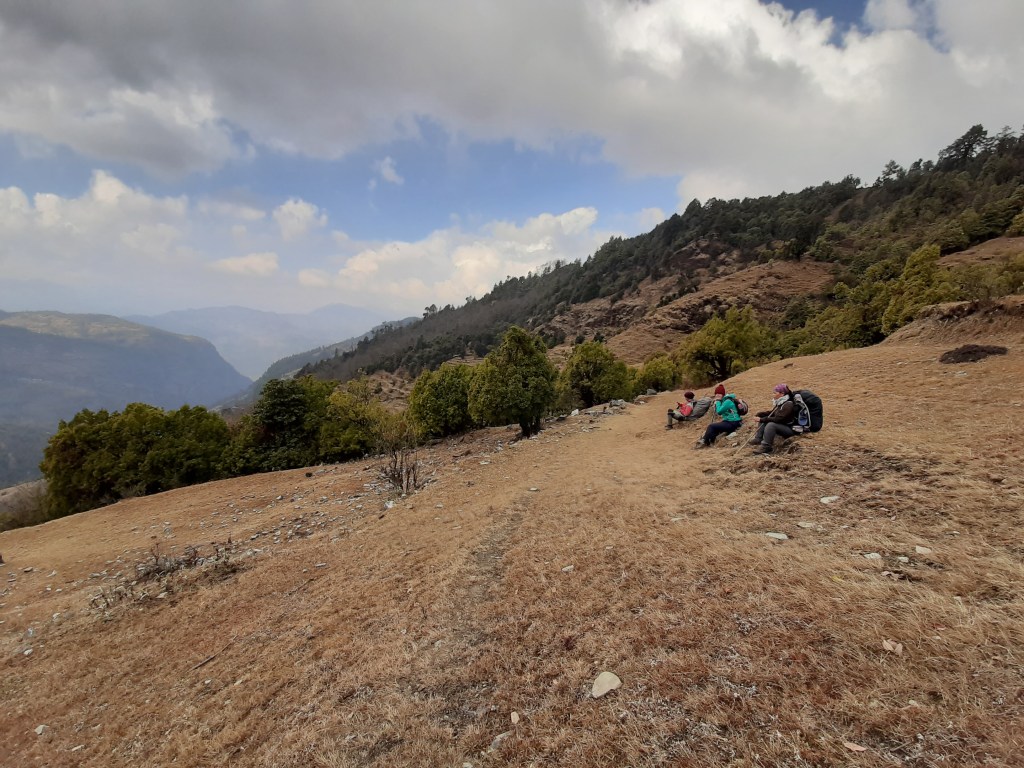
Day 5, 20th Jan, Phulbari to Poon Hill (3,200m) to Ban Thanti (2,600m)
We woke on day 5 from what had been the coldest night by far to find condensation frozen on the inside of our window… When we got up, though, we were treated to the most sensational dawn views we have ever seen. The skies were completely crisp and clear and sun was only just starting to touch the peaks of Daulagiri, Annapurna South and the other massive peaks that made up the panoramic view in front of us. Wow! After breakfast, we witnessed the 2 Nepali lads make a second attempt at the path towards Mohare… it was equally forlorn. After getting buried once again, they resorted to rolling down the hill while filming each other, which, of course, meant they had to dry all their clothes once again.
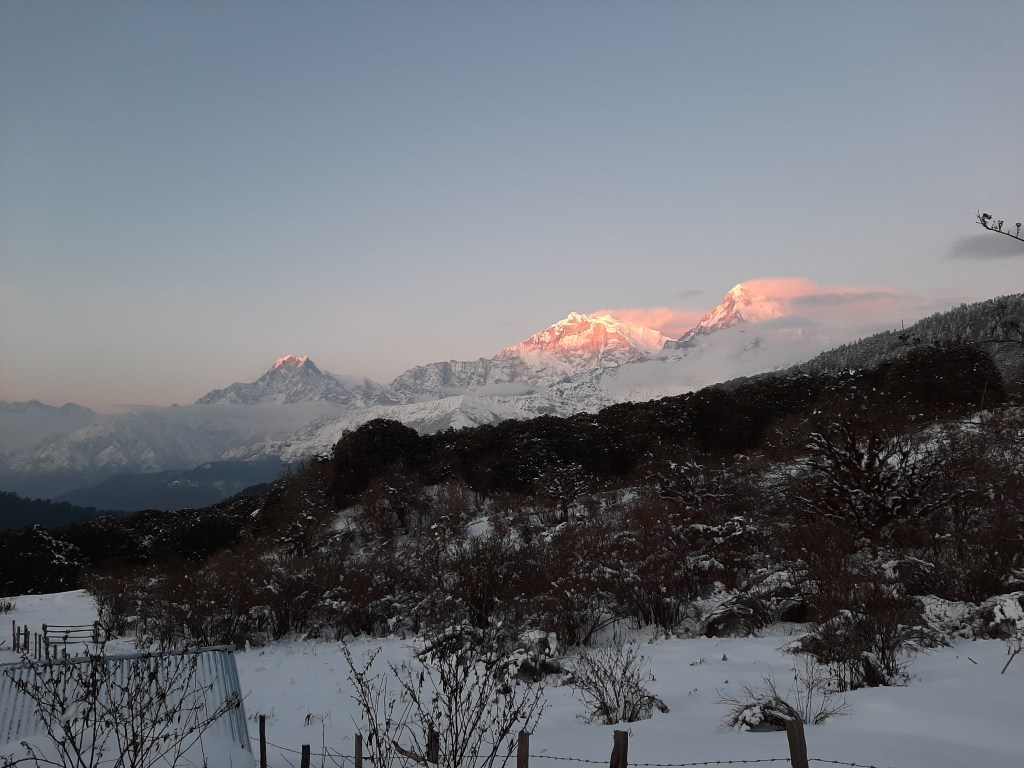
We set off from Phulbari on the trail for Poon Hill. The path first passed through thick rhododendron forest where we would occasionally have glimpses of the massive peaks from small clearings. Quite quickly, the snow started to become much thicker and more powdery such that you would sink in thigh deep. Any path that had been created by previous walkers had been buried by yesterday’s fresh dump of snow. Abicheck led the way with his longer legs and Shanti who is 5 foot 1 at best struggled, getting buried waist deep on a couple of occasions. Every step was hard work. Yet as tiring as it was, it was certainly an adventure and we just kept gawping at the phenomenal views all around us as we were now bathed in warming, bright sunshine.
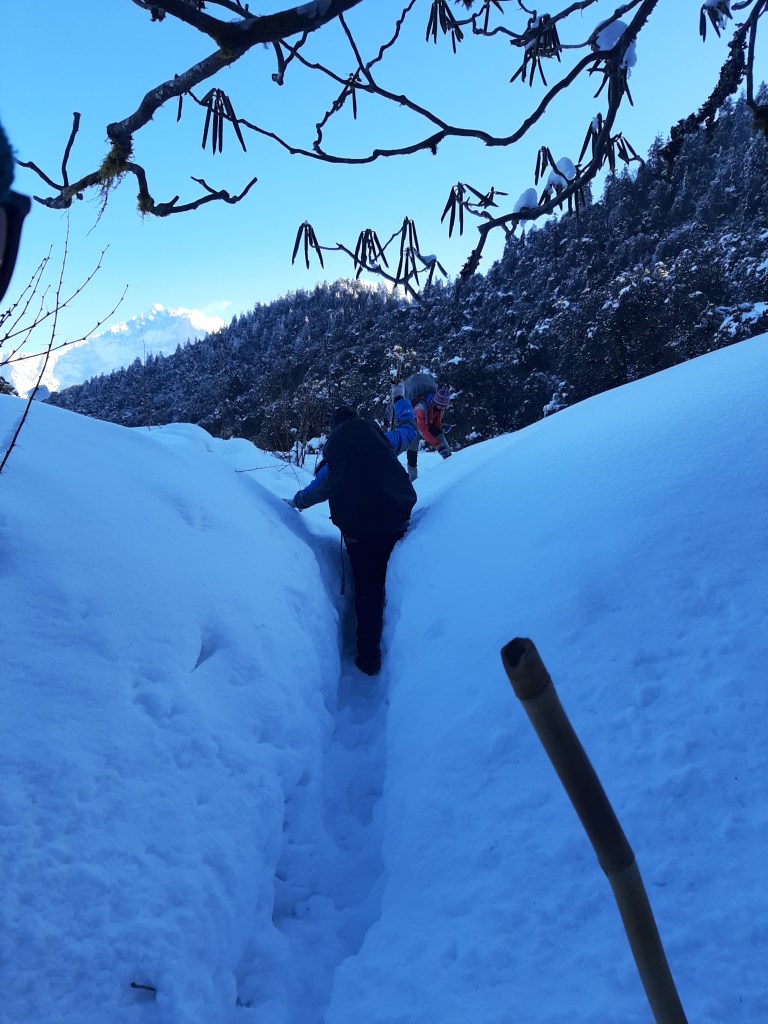
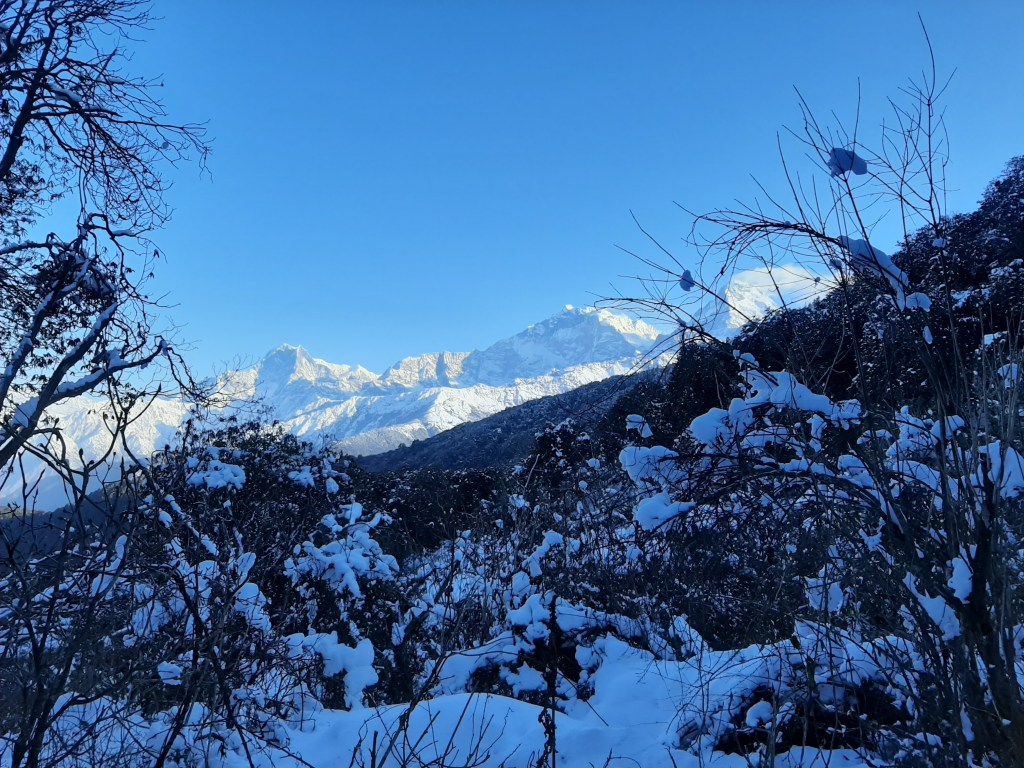
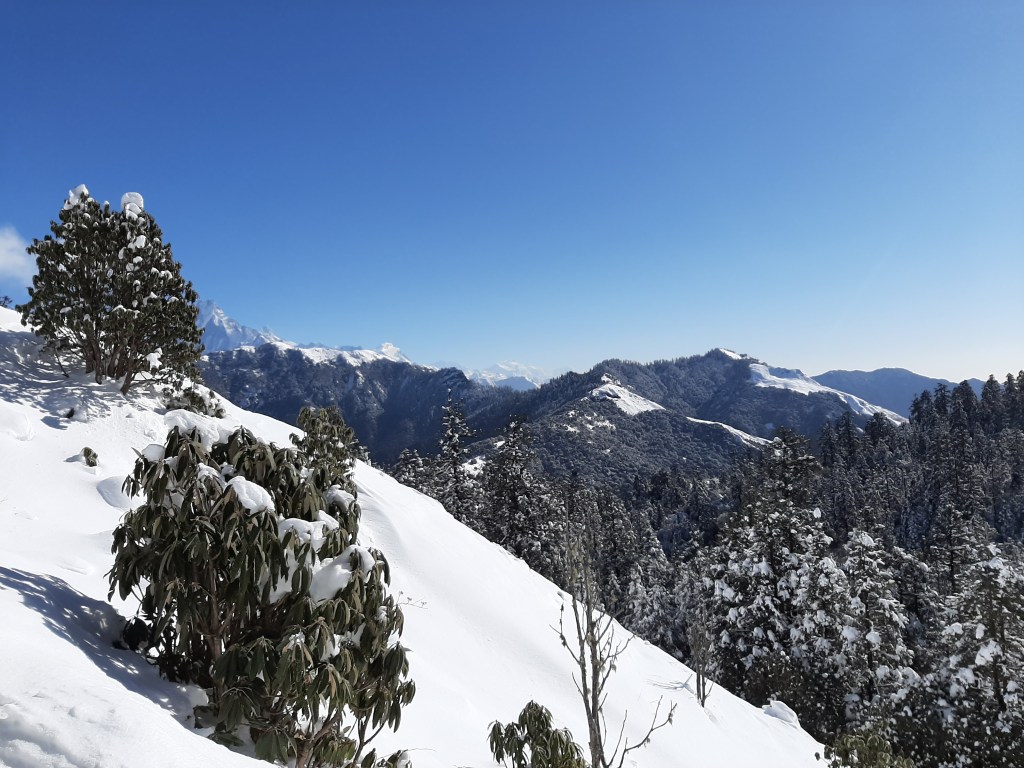
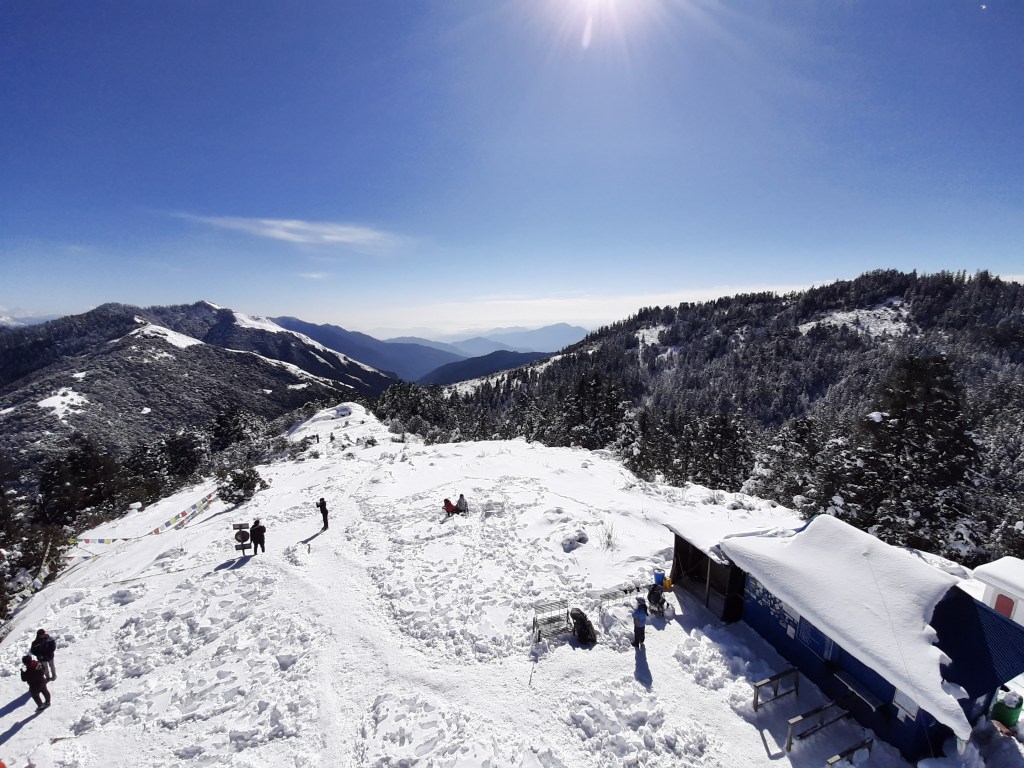
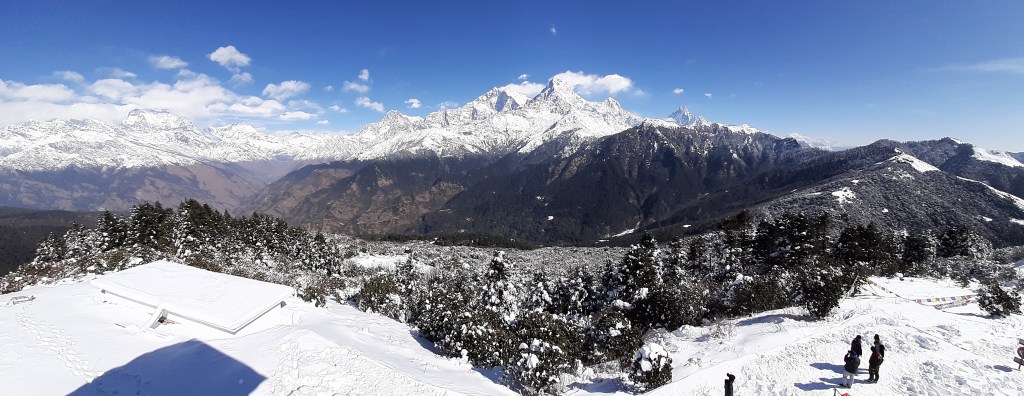
After a good hour and a half or so, we reached the summit of Poon Hill. Katharine and Shanti both changed socks as they had become drenched with snow getting in. A tall viewing platform / watch tower has been built as well as a small shop that was now closed. It was very obvious that we had suddenly arrived in the well trodden and popular trekking paths: there was a large group of Nepali trekkers also at the top and the path heading down to the resort village of Ghorepani was so well trodden it may as well have been shovelled clear. It was obvious why this spot was so popular though… as the last peak before the massive mountains rise straight up to terrifying heights, Poon Hill makes a simply phenomenal vantage point for 360° panoramic views. The fresh snow and glorious cloudless skies simply made it perfect and more than vindicated our decision to delay making the hike until that morning.
After soaking up the views and getting plenty of photos, we walked down hill for about 30 minutes to Ghorepani. Ghorepani has become a massive hub for the area with a resorty feel. It was a bit of a shock to the system having become used to authentic villages and no other trekkers! Nonetheless, we enjoyed a lovely lunch at one of the tea houses with more phenomenal panoramic views.
Given the conditions on Poon Hill and Mohare, we took the sensible decision to not attempt the hike up to Muldai peak (3,700m). We had been excited by the prospect of climbing to a higher altitude than either of us had been in the Alps but we learnt nobody had been attempting that path, and, in fact, the owners at the tea house in Dobato (our planned overnight stop) had descended down the mountain as there was no running water or means of getting food up there! Instead, we would be heading straight towards Ghandruk and spend more time exploring that side of the foothills. As there were so many tea houses along this trail, we had flexibility on where we wanted to spend the night, with the hamlet of Ban Thanti as our favoured (and furthest) target.
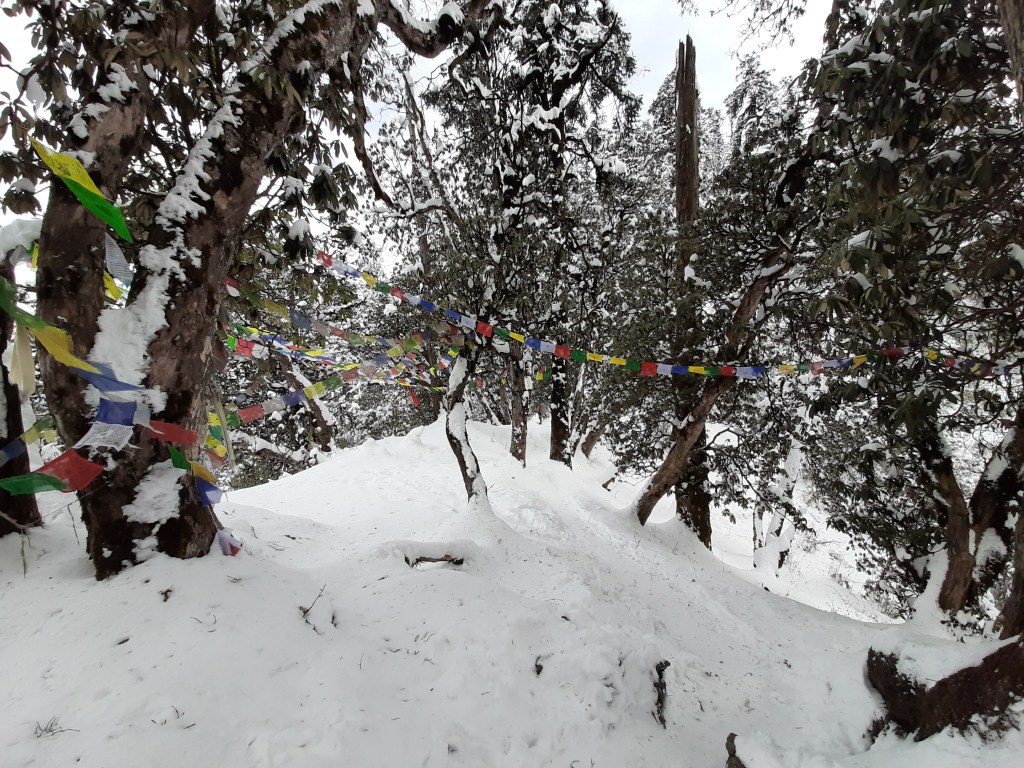
We set off after a nice long break and stocked up on some coke and Mars bars to give us energy for what was to be the longest day so far. The well-trodden trail climbed steadily through more rhododendron forest with the trees shedding snow – occasionally on us – having been warmed by sunshine throughout the day. After passing through two clearings, we eventually came to the first of two passes (“Deurali” in Nepalese) which had a cute wooden shelter that was also a tea spot, though unmanned at this point. We were now walking on a snowy ridge, with stunning scenery on each side and prayer flags hanging from tree to tree at a few points – it was really beautiful and clear why this trek is so popular and why it is called the Annapurna Panorama trek!
Eventually, the path started descending down the north side of the ridge. We reached the second deurali which had a couple of nice tea houses and is also where we would have turned to follow our original route to Muldai. Shanti pointed out where the trail normally was: just seriously deep snow where nobody had trodden. We stopped for tea in one of the log cabins. At each such stop Shanti and Abicheck would chat with the staff, and it was always about where we had come from/ where we were going, local news of the trails in the area or any news about the massive avalanche that had buried a few Korean tourists and Nepali guides a couple of days earlier. We continued down hill in heavily snowed and shaded northern slopes. After 15 minutes, the path descended into a snowy gorge and the path grew steep and very icy – our microspikes proved immensely useful as we watched other trekkers clinging onto the ropes on the side of the path to stop themselves from sliding about. Abicheck found a large plastic bag and started using it as a sledge down some of the steeper parts of the path making all sorts of flying and giddy sound effects. He was clearly having fun (unlike some porters we saw who seemed to be carrying ridiculously heavy and dangerous weights), and it was nice that he felt able to relax in our company!
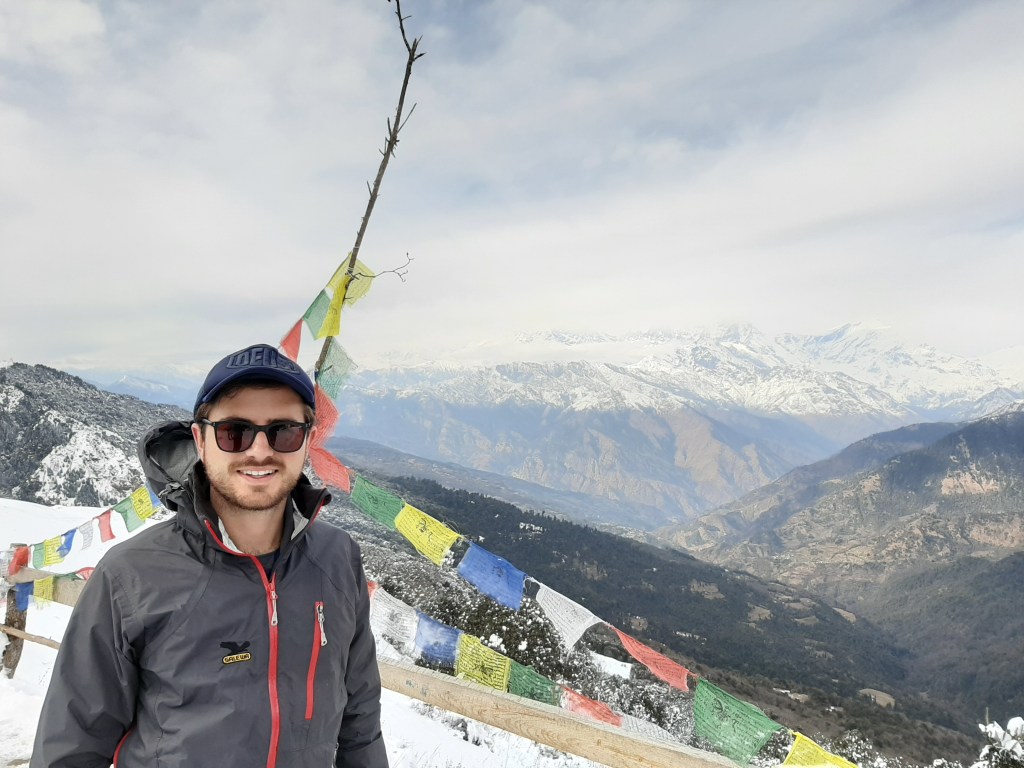
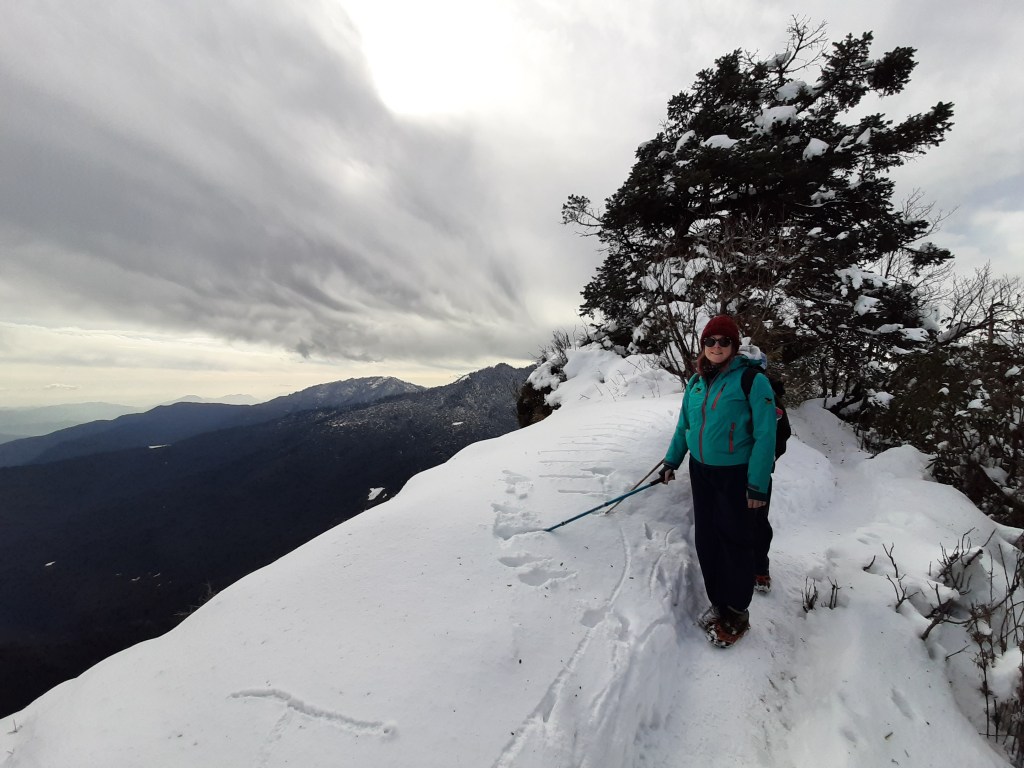
After another hour or so of walking down, the snow started to thin out and we reached the hamlet of Ban Thanti – our stop for the night. There were a good 3 or 4 tea houses here, but Shanti immediately knew which one had the best food and beds – one of the many pluses of having her with us! This was the first teahouse where we met other western trekkers, and also the first place that had a TV! We spent a good few hours chatting to three French guys who were on a 10 month trip and a Scottish father / son, as well as the various guides / porters. It was a lovely, relaxed and sociable feel to the evening. It was interesting hearing stories from the Scottish dad in particular – an A&E paramedic in Glasgow – about how Glasgow has changed over the years, as well as how he was on duty when victims from the helicopter crash in a Glasgow pub not so long ago were brought in to the hospital. Meanwhile, Abicheck for most of the evening was transfixed on the TV which was showing a series of Bollywood films and then Mission Inpossible dubbed in Hindi.
Day 6, 21st Jan, Ban Thanti to Kotte Danda (2,300m)
The shortened length of our overall trek meant that our final 2 days were at a nice and relatively leisurely pace. We left Ban Thanti around 8.30 am, after waving goodbye to our friends from the previous night who were heading towards Ghorepani (where we had come from). While the snow had certainly thinned, patchy snow and ice persisted for most of the morning, which proved tricky to navigate, particularly given our morning entailed a steep descent into the bottom of the valley and up the other side. After an hour and a half of not the most fun walking, we reached the village of Taddapani – something of a hub and crossroads in the area for many trekkers. We had a masala tea break here and decided on which route to take next – we opted for the slightly longer route with better views.
From Taddapani, we walked for another hour and a half or so downhill, first through forest and then meadows. By the time we reached the hamlet of Chiule, we had left the patchy snow and ice behind us. The walk was enjoyable with nice views looking down and across the valley. Shanti had been telling us stories of a Brazilian woman she had guided a number of times who speaks no English. At times this put them in difficult and dangerous positions where Shanti was not able to properly communicate the risks of them continuing to ascend where the Brazilian lady was suffering badly with altitude sickness… We enjoyed lunch and more chapati apple pie at a large tea house in Chiule which had a big front garden with picnic tables and gorgeous views of the surrounding mountains. There was a puppy and its mum also playing about in the grass that were super cute – the traditional Nepali breed we kept seeing that are mostly black with dashes of white and adorably fluffy.
We continued after lunch in increasingly rural terrain – across more terraced land and through a lovely village with smiling locals and stone houses. Shanti had created an incredible set of tongs from bamboo using a machete and was using it to pick nettles to cook at home. There were so many nettles – big thorny ones that are nastier looking than their European cousins – Shanti easily filled a plastic bag. Our path eventually started to climb again through more forest until we reached the hamlet of Komrong Danda where we started seeing signs to our final destination: “Little Paradise, 25 minutes”! The path to this Little Paradise at Kotte Danda was along a ridge and grew steeper again until we came to a stunning meadow with amazing 360° views: to the south, the village of Ghandruk and to the north the trail to Annapurna base camp, up an increasingly narrow valley with huge steep slopes on either side. It was a weird feeling looking directly at the spot where we knew the big avalanche had claimed lives just days before.
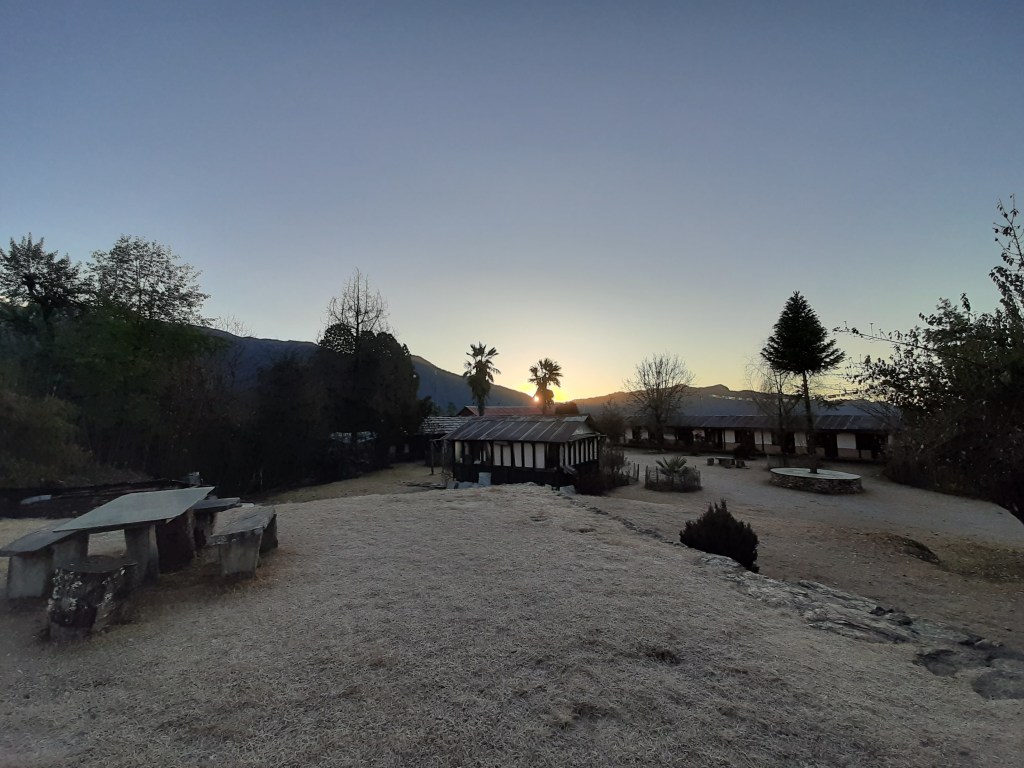
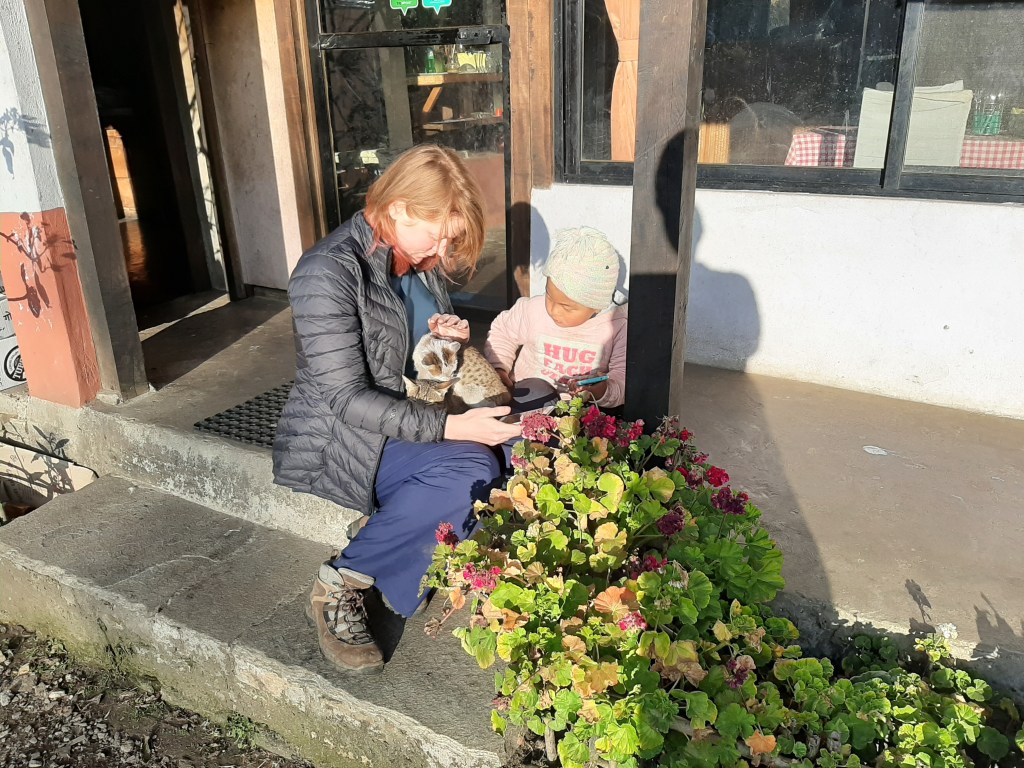
When we arrived at Little Paradise, the place felt exactly as the name suggested! We were greeted by two fluffy Nepali dogs who escorted us through beautiful spacious gardens to the lodge itself. There were flowers all around and a couple of picnic tables and we sat in sunshine, enjoying our first Ghorka beer of the trek with stunning views surrounding us. The teahouse is family run with three generations living there, including the granny and little girl (no older than 3). Little Paradise seemed totally self sustainable – they had plenty of vegetables growing in the garden, chickens roaming around, a small herd of cows and cats lounging (unless they were being pestered by the toddler). It was all in all an idyllic and beautifully relaxing spot to spend our final night trekking. We spent the evening relaxing and catching up with the world (this was our first internet for a few days!). That night the skies were clear and revealed probably the best night’s sky we had seen given the seclusion of Little Paradise. We even had our poshest accommodation here: a proper brick and mortar building with our own private bathroom and genuine double bed!
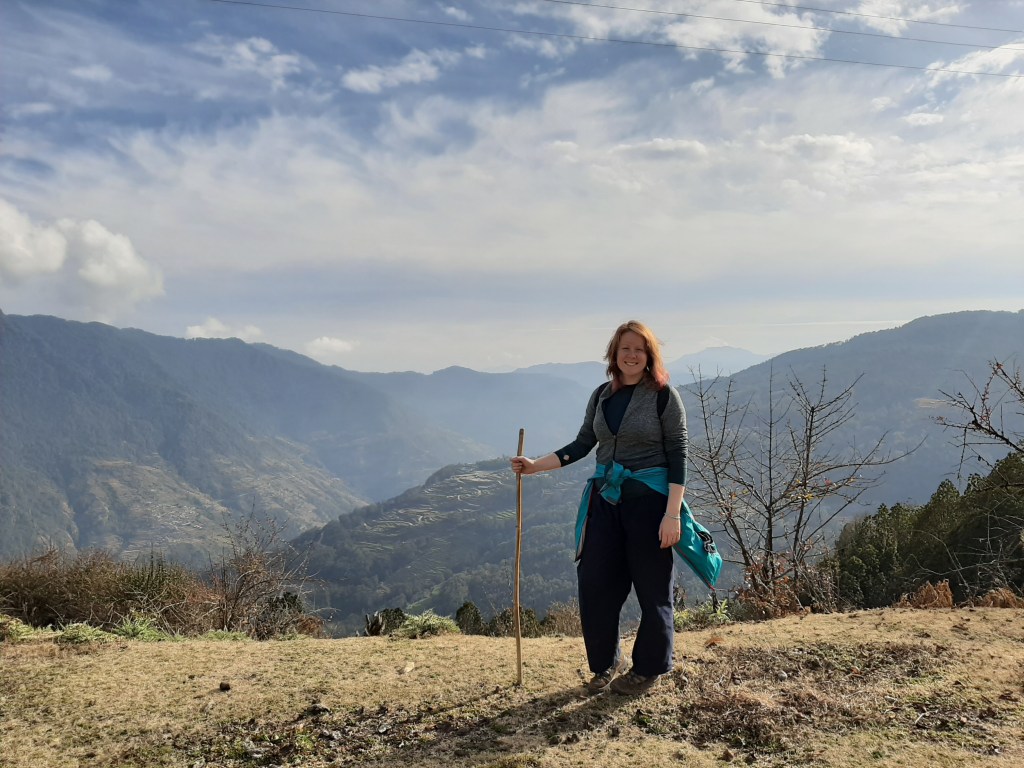
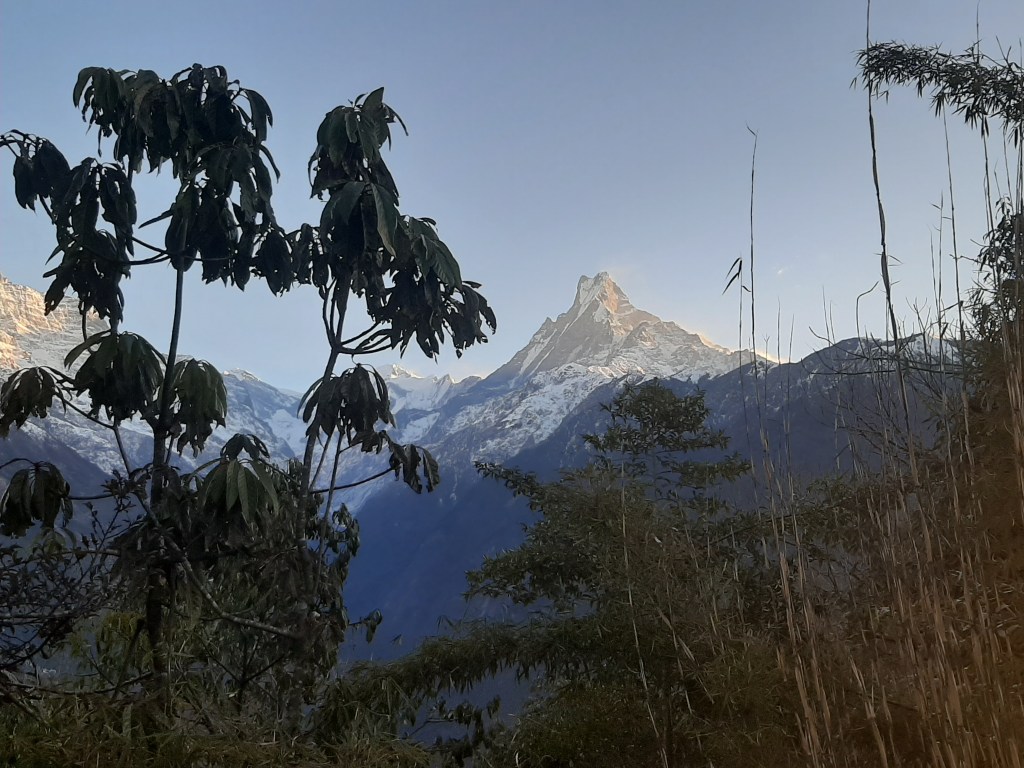
Day 7, 22nd Jan, Kotte Danda to Kimche (1,600m) to Pokhara (900m)
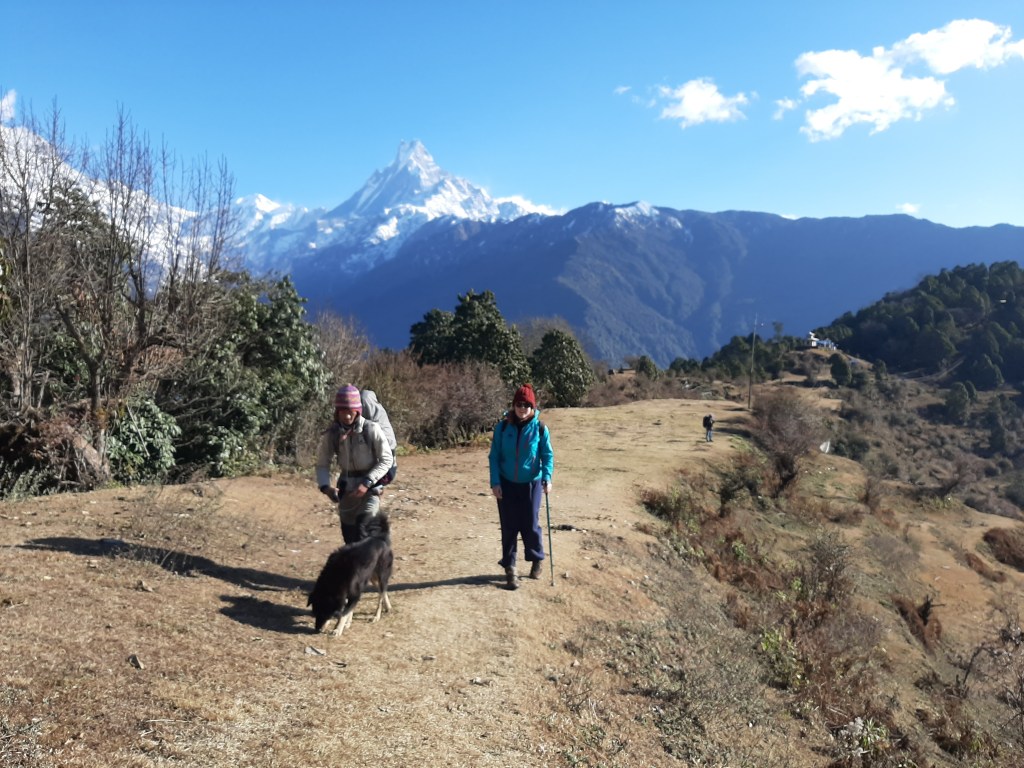
Our final day trekking had a relaxed, tired and slightly nostalgic feel. We woke to gorgeous sunshine revealing what had been missing from the views on the previous day: peaks! We were right in the shadow of Annapurna South (7,200m), Hiunchuli (6,400m) with the hugely impressive, steep Machapuchre (7,000m) aka Fishtail mountain, and comparatively tiny Mardi Himal (5,500m) both towards the north-eastern side of the valley.
We had breakfast and bid farewell to Little Paradise. The dogs escorted for 15 minutes along the path back to Komrong Danda before returning home – apparently this is what they do every time with guests! At Komrong Danda, we turned left and continued down a large and well trodden trail along the mountain side towards Ghandruk. On our final two days of walking, we had come across a number of mule-trains carying building material up the mountain. Each was being frantically hounded by one or two locals at the rear, making the poor animals move at dangerous speeds, both for themselves and for any trekkers like us who had to rush to the side of the trail to take cover!
There is no doubt that development is and has been coming quickly to this part of Nepal primarily driven by road networks have been expanding but also better sanitation, access to clean water, education and money leading to local pockets from trekkers. Roads (albeit unaurfaced and very bumpy) on the one hand impact the trekking industry (with risks of tourism incomes falling), where picturesque mountain trails are replaced by boring roads. The flip side is that villages get far greater economic power- using communal jeeps, they can operate independent shops and businesses to bring in wealth. In times of drought or bad harvest, it also means they have access to other food sources where they cannot live of their own produce. So long as development happens in a sustainable way and new building happens in keeping with traditional methods and aesthetics, there seems no reason why a balance cannot be struck. Indeed, the Annapurna Conservation Area have been creating new trails for trekkers to help maintain that balance.
After walking for an hour and a half, we arrived at Ghandruk. While the village was undeniably picturesque, and the looming Machapuchre in the foreground provided an additional level of beauty to the place, it was no more interesting than the quieter and more rustic villages we had seen during our first few days trekking. We visited one of the Gurung museums in the village, which was effectively a collection of local traditional tools, crafts and clothing used by Gurung peoples in the area. Shanti got hands on here and proved an excellent guide once again, showing us the various uses of bamboo baskets, lanterns, butter churns etc. etc.
We stopped for an early lunch just a little further around at a teahouse with a lovely garden and beautiful views overlooking the valley and the village of Landruk opposite. Today was the first day we felt genuinely warm and shifted down to one or two layers. Now at a much lower altitude and with bright sunshine, we enjoyed basking in the sun and eating outdoors. Throughout the day we had felt strangely tired and lazy, and so did Shanti. We reasoned that our bodies knew this was a short and final day and so were already behaving like it was over!
After a tasty and leisurely lunch, we paid a visit to the Anapurna Conservation Area HQ and visitor centre, where a former colleague of Shanti’s was working. We watched an education video about the organisation which was interesting but was mostly a highlights package of what to see around Annapurna. Katharine’s uncle Randall would teach his geography students about the Annapurna Conservation Area as a sustainable tourism and development case study, making this visit that bit more special.
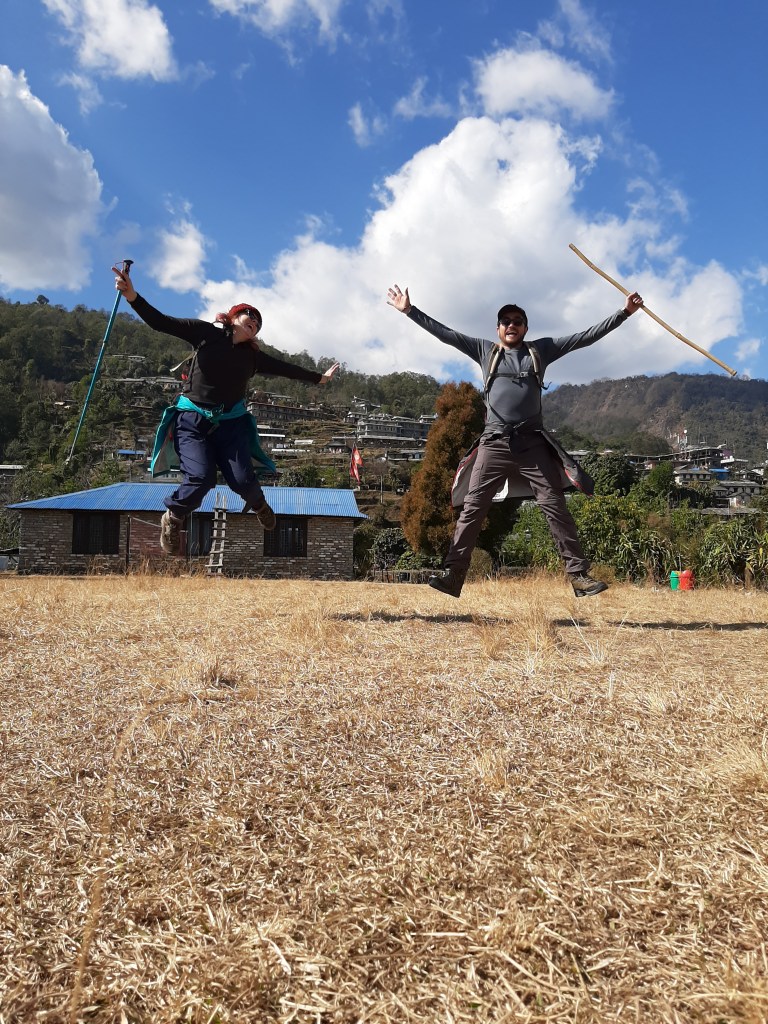
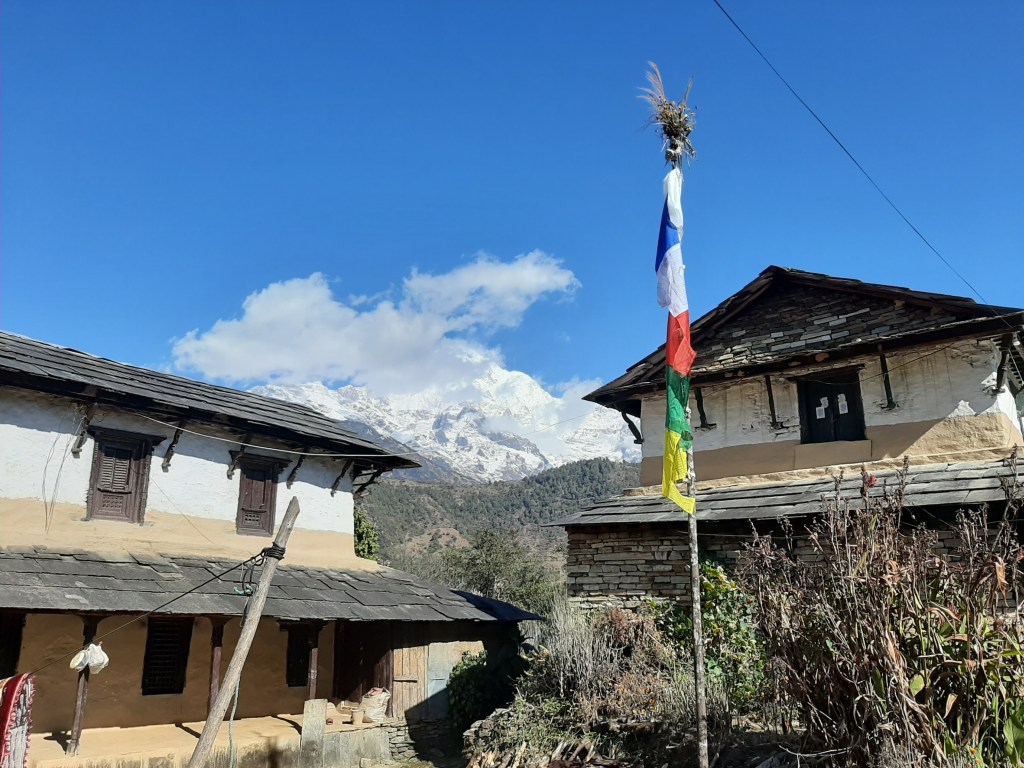
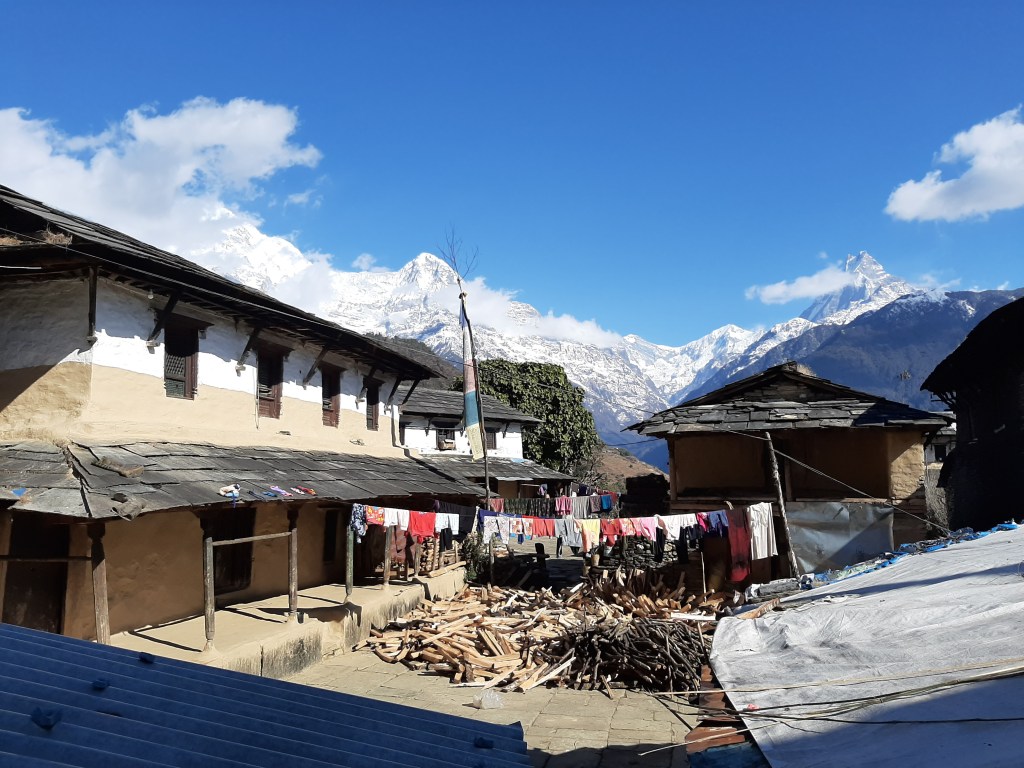
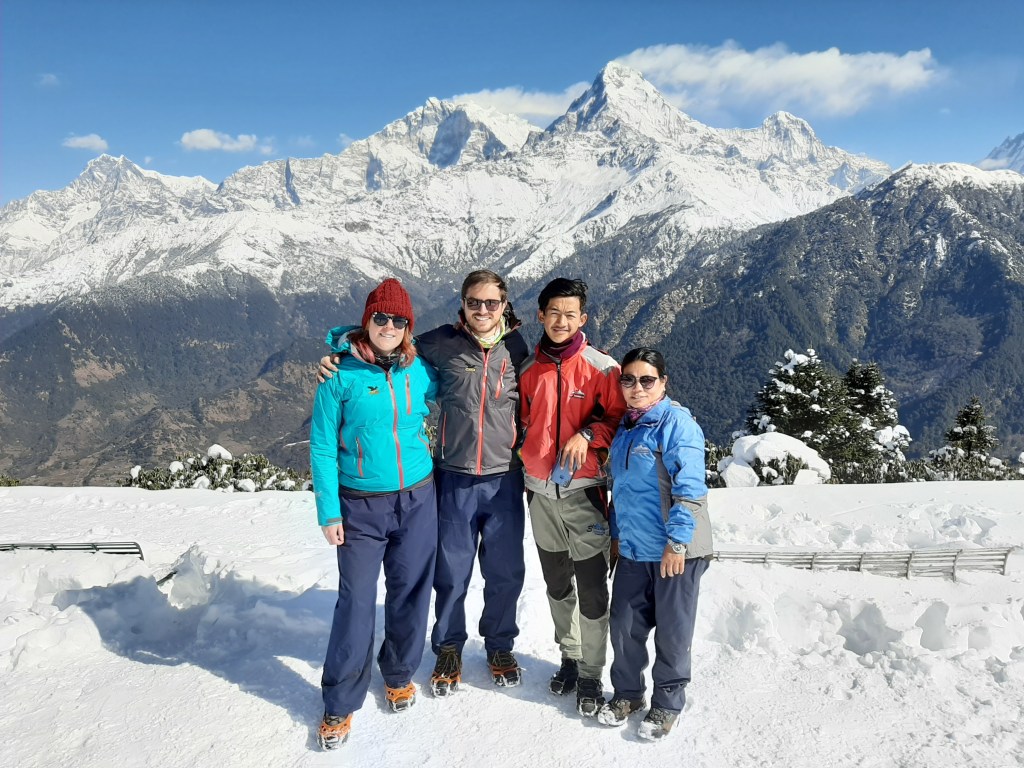
Our planned pickup point was the village of Kinche, given that the walk would have entailed walking on a somewhat dull road, and the village itself was nothing special, Shanti had proactively arranged for our jeep to meet us a little higher up. We came to the road and met our rise out about 30 minutes walk from Ghandruk. We had a quick look at a Nelapi paper-making “factory” just by the road, with lots of ladies working pressing and drying these rustic sheets in the sun. After a somewhat emotional end-of-trek photo, we jumped into our Tata jeep and trundled down the slow road towards Pokhara. The journey took about 3.5 hours in total and we were all pretty sleepy and quiet throughout (apart from the excitable driver who seemed to want all the gossip from Shanti and Abicheck).
It really had been the adventure of a lifetime, to rival our epic journey across Serengeti and Ngorongoro in Tanzania. Shanti and Abicheck were huge parts of what made it a fun experience. We were considering the option of going solo for added independence, but having their knowledge of good tea houses, local, quieter routes, local conditions, local customs and ways of life, and ultimately being great walking companions really helped make the trip special (not to mention not having to carry the bulk of our stuff!). We had emotional farewells outside the trekking agency in Lakeside, Pokhara and exchanged Facebook details.
Onwards and eastwards:
With our trek completed, the next leg of the megamoon took us towards Southeast Asia, with a flight booked from Kathmandu to Bangkok two days later on the 24th Jan. We headed back to Zostel where we had left our backpacks and would be spending the night again. That evening we sorted our bus tickets for Kathmandu and decided to treat ourselves for dinner… We visited the Everest Steakhouse, which boasted to have the best steak in the world..! While we were sceptical given this was a country that largely does not eat beef on cultural and religious grounds, we ended up enjoying a hugely tasty chateubriand fillet steak and a whole range of interesting sauces and vegetables. The portion was simply monstrous and incredibly tasty and did not cost any more than 15 pounds in total… Feeling incredibly full but happy to have eaten something that was both not Dal Bhat and was delicious, we returned to Zostel. We thought we would have another go at socialising given how fond we had grown of the place. We only encountered one of the beardy, long haired staff playing guitar and one Indian guest having a go on a drum. He ran a tech startup in Mumbai but was totally disinterested in us so we swiftly went to bed.
We had an early bus to Kathmandu the next day. Unfortunately, the kitchen staff forgot about our request for early breakfast (or they overslept) and so we headed off towards Lakeside. Luckily, we managed to grab a quick muesli and curd while waiting for the bus. The bus ride back was uneventful and seemed to go past fairly quickly (even though it was a good 6+ hours). We were somewhat annoyed that this alleged “Tourist bus” did not stop at Thamel (the backpacker area where we were staying) and instead terminated at the main bus station, several kilometres north. On top of that the bus conductor, who had been pretty unpleasant throughout the journey, suddenly started being nice as we were leaving and asked for 50 rupees “for my family”. You are not meant to encourage begging at any rate as a sustainable tourist – especially in countries like Nepal where the needy are provided for by temples. But having a healthy and fully employeed man treat us as nothing more than a walking talking wallet, was a little upsetting.
We found a taxi to take us to the Zostel branch in Thamel. The place had a similar feel to the hostel in Pokhara (albeit without a lake) and the room was excellent for the price. We had dinner at the simple, cheap and tasty Tibetan restaurant we ate on our first night in Nepal, some 18 days before. We also visited the excellent Pilgrim Bookshop, where we bought a second diary for Katharine (on course for running out of pages in her first one), made with traditional Nepalese paper, bought postcards and browsed their great collection of books. After skyping George’s grandparents for his grandad’s birthday from the colourful streets of Thamel, we headed into the rock club, Purple Haze. It was hugely impressive! With a large stage and large open space with tables and dancefloor, you would never imagine the place from the narrow streets below. The band were proper Nepali rockers who played a series of classic covers with the odd local hit thrown in. We had a few drinks enjoying the music and then headed to the Everest Irish bar – our favourite from our previous visit in Kathmandu. The craic was less good this time so we swiftly headed back to Zostel.
Our final morning in Nepal was uneventful. We had a bit of a lie in, went to retrieve laundry, had breakfast and headed to the airport. Our two and a half weeks in Nepal had really been incredible. From the mad but fascinating streets of Kathmandu, the royal splendour of Patan to Himalayan villages and monstrous heights of the Annapurna range. Onwards to Bangkok and southeast Asia!
 tranetrottingthemegamoon.travel.blog